
Blog

Sandboxing the code AI agents run, and the systems that make it dense and fast. Engineering deep dives and security notes from the Cosmonic team.

Customize wash CLI with Wasm Plugins
||5 min read

Cross-posted from the wasmCloud blog.

In wash v0.28, we introduced wash plugins: a simple system for extending the wasmCloud Shell (wash) CLI with WebAssembly components. Users can install plugins from OCI registries, local files, or over HTTP, then execute the plugin as a subcommand to wash. Plugin developers simply build a given piece of CLI functionality as a component.

In this post, we'll show you how to install your first plugin. In themselves, plugins represent powerful, versatile tools that will accelerate workflows and help developers tailor tooling to their needs. But wash plugins are also a great example of how modular CLIs can be implemented with WebAssembly—and how components can accelerate development across a team.
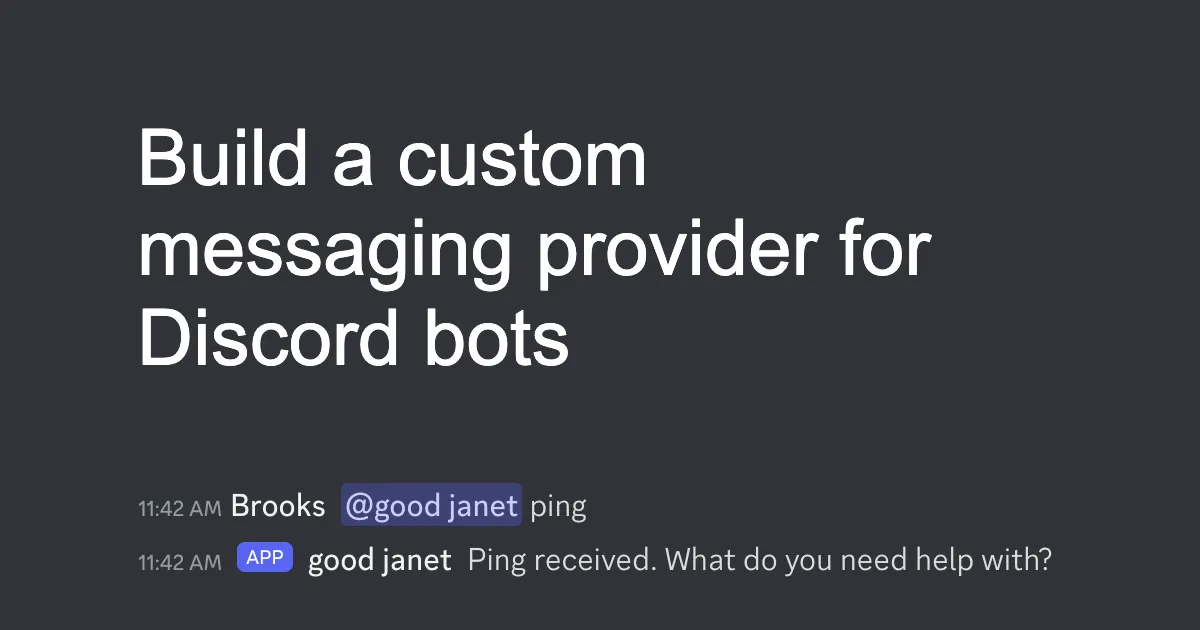

Build a Discord Bot Provider for wasmCloud
||13 min read

Cross-posted from the wasmCloud blog.

A couple weekends ago I found myself wanting to write a Discord bot: specifically, a simple bot that I could tag with a message to trigger some processing and a response message. As I started thinking about what this bot could do, I realized this was an excellent use-case for a provider: instead of writing a one-off bot, I could create a reusable provider that would make it trivial to build any Discord bot I wanted.

The Discord API is fully-featured and massive, but for such a simple use-case, it would be overkill to work from scratch every time you wanted to write a bot. With a custom provider, I could simply write a component in any language and then plug it in to my provider via a simple API.

In this post, I'll retrace my steps to implement the custom provider using the wasmcloud-messaging interface, and show you how you can use the provider to write Discord bots of your own.

wasmCloud Operator: Open Source Wasm on K8s
||6 min read

Cross-posted from the wasmCloud blog.

SEATTLE, (Open Source Summit), April 16, 2024. In response to growing demand among engineers for more open and community-led ways to bring the benefits of WebAssembly (Wasm) to Kubernetes, Cosmonic has contributed its Kubernetes operator to the CNCF wasmCloud ecosystem. The wasmCloud-operator (formerly known as Cosmonic Connect Kubernetes), allows Kubernetes practitioners free and unfettered access to wasmCloud in their own Kubernetes clusters, deployed and managed with the tools they know and trust.

Highlights and Insights from Wasm Day EU, 2024
||10 min read

Cloud Native Wasm Day (co-located with KubeCon + CloudNativeCon EU, 2024) is always a great event but this year was a little different. In 2024, discussions are turning from theory towards working with Wasm in practice, with companies in a variety of sectors sharing their experiences.

What's particularly exciting for us, as CNCF wasmCloud maintainers, is how quickly wasmCloud is being adopted. So many of this year's talks come from companies already working with wasmCloud---many in production. We've summarized all the talks from this year's event and recommend paying particular attention to presentations from wasmCloud community users Orange and Machine Metrics.

Wasm I/O & KubeCon EU 2024 Preview
||10 min read

We’re excited to see our friends again as we embark on a whistle-stop tour of two of our favorite European events (and cities) in the 2024 conference calendar: WASM I/O, Barcelona and KubeCon + CloudNativeCon Europe 2024, Paris. With the release of WASI 0.2 and the WebAssembly component model, we’re taking wasmCloud 1.0 on tour—introducing it to cloud native developers, and platform engineers, as the best place to bring components to life in production environments.

WASI 0.2.0 and Why It Matters
||8 min read

WASI Preview 2 officially launched! After a vote in the WASI Subgroup of the W3C WebAssembly Community Group, the standard set of interfaces included in the launch of Preview 2, aka WASI 0.2.0, is ready for use by library implementers. We've been closely tracking the different release candidates of WASI 0.2.0 over the last 6 months, and wasmCloud will update its runtime WIT definitions to the pinned versions in just a few days.

WebAssembly in Telecoms with wasmCloud
||11 min read

As core contributors of CNCF Sandbox Project wasmCloud, it's always exciting to see specific industries prove that Wasm can bring real-world benefits and efficiencies. In particular, we love seeing how Wasm can compliment existing technologies—our work with Adobe is a great example of how wasmCloud can enhance Kubernetes infrastructures. On the reverse side of the same coin, a new use case, developed within the operations and services (OSS/BSS) side of the telecoms industry, has revealed the potential of Wasm as a replacement for Kubernetes.

Do you need runwasi to run WASI?
||9 min read

If you’ve been following anything in the Cloud Native space right now, chances are that you’ve heard of WebAssembly (Wasm). As someone who works at a Wasm company, it should come as no surprise that I think Wasm is the future of software development. But, let’s be honest, you probably aren’t going to just dismiss Kubernetes and go all-in on the first Wasm-related project you find.

At Cosmonic, we’ve always believed it important that Wasm and wasmCloud (the soon-to-be incubating CNCF project we contribute to and help maintain) are compatible with, but not dependent on any pre-existing technology. Guided by that principle, we have long provided integrations with Kubernetes, as most people operating in the cloud native ecosystem are running in or integrated with it. What has been interesting to see is how people are choosing to integrate with it. This post outlines a couple of ways to integrate Wasm with Kubernetes, and it gives a clue as to why we’ve designed our platform to integrate with Kubernetes the way it does. With that in mind, let’s dive in!