From Prompt to Production: Sandboxing the Vibe-Coded Enterprise
What changes when AI writes the code your business runs — and how platform teams keep shipping fast without inheriting the risk.
Every agent action, tool call, and AI-generated program runs in a deny-by-default WebAssembly sandbox — on the Kubernetes you already operate.
A model doesn't have to be compromised to be dangerous — it just has to be persuaded. Sandboxing bounds what a persuaded model can do.
Adversarial input in a document, tool output, or chained agent hijacks the model's instructions. In a sandbox, even a fully hijacked step can only use the capabilities that step was granted.
An agent with ambient network access can send anything it reads anywhere it likes. Capability-scoped networking means outbound connections exist only where you declared them.
One bad tool call shouldn't become a beachhead. Each sandbox starts empty — no credentials, no shared filesystem, no path to its neighbors — so an attacker who lands in one has nothing to steal and nowhere to go next.
An AI sandbox is an isolated execution environment for code you can't fully trust — AI-generated programs, LLM tool calls, MCP servers, and autonomous agent actions. It exists so that the worst thing untrusted code can do is bounded before it runs.
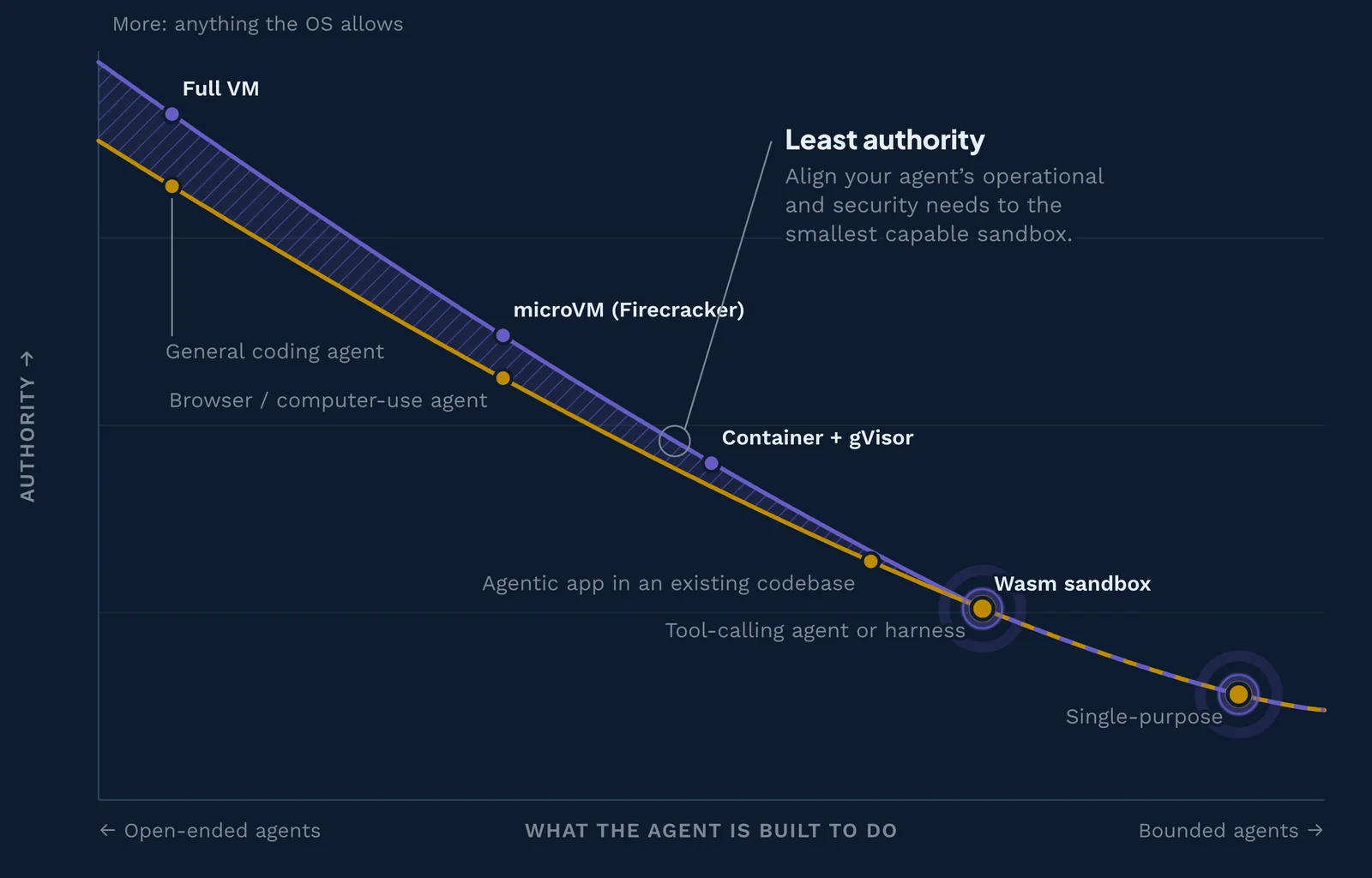
Most sandboxes start from a full computer and subtract: strip syscalls, filter networks, wrap kernels. WebAssembly components invert the model. A component starts with nothing — no filesystem, no network, no clock, no environment — and receives only the capabilities its task explicitly requires. Security people call this the principle of least authority; for AI workloads it's the difference between hoping a model behaves and not needing it to.
Because instantiation costs less than a millisecond, isolation gets cheap enough to apply per invocation — every tool call gets a fresh sandbox, and nothing persists between calls unless you say so.
Containers, microVMs, and Wasm components all isolate — the difference is what that isolation costs at agent-traffic scale.
| Capability | Containers | MicroVMs | Wasm components |
|---|---|---|---|
| Isolation model | Shared kernel, broad syscall surface | Strong, VM-level | Capability-based, shared-nothing — least privilege by default |
| Cold start | Hundreds of ms to seconds | ~100 ms to seconds | Sub-millisecond |
| Density | ~100 per node | Lower — per-VM memory overhead | 10,000s per host |
| Scale-to-zero | Possible, with cold-start or warm-pool cost | Pre-warmed pools idle expensively | Native — restart is effectively free |
| Per-call isolation | Impractical at agent volume | Costly | Practical — fresh sandbox per invocation |
Cosmonic Control is a Kubernetes-native control plane: CRDs and an operator, not a parallel platform. Your namespaces, RBAC, ingress, GitOps, and observability keep working.
One Helm install adds the operator and CRDs to your cluster. Works with your admission policies and existing supply-chain controls.
Ship agents, MCP servers, and functions as Wasm components via OCI registries — declared, signed, and versioned like everything else you deploy.
Workloads implement the Kubernetes /scale subresource, so HPA and KEDA autoscale sandbox instances across hosts — including scale-to-zero.
What changes when AI writes the code your business runs — and how platform teams keep shipping fast without inheriting the risk.
Why deny-by-default beats permission subtraction, and what it means for workloads that think.
Read the concept → Concept · DocsHow explicit grants replace ambient authority — the mechanics of what a sandbox can and cannot reach.
Read the concept → Concept · DocsWhat changes when the code deciding your I/O was written by a model at runtime.
Read the concept → Guide · BlogA practitioner's tour of sandboxing options for AI workloads — trade-offs, benchmarks, and when each fits.
Read the guide → Hands-on · DocsRunning MCP servers? Go from an OpenAPI spec to a sandboxed, production-ready MCP server on your cluster — step by step.
Start deploying →An isolated execution environment for code you can't fully trust — AI-generated programs, LLM tool calls, MCP servers, and autonomous agent actions. It contains what the code can touch, so a manipulated model or malicious output can't reach the network, filesystem, or credentials beyond what the task explicitly requires.
Agents inherit the permissions of wherever they run. A prompt-injected agent with host-level access can exfiltrate data, move laterally, and execute arbitrary code. Sandboxing every tool call in a deny-by-default environment bounds the blast radius of any single manipulated step — even when the model itself is fooled.
Containers share the host kernel and expose a broad syscall surface; hardening them for untrusted code means microVMs, warm pools, and cost. WebAssembly components run in a shared-nothing sandbox with capability-based security: zero ambient authority, explicit grants for every I/O path, sub-millisecond instantiation, and thousands of instances per node.
Yes. Cosmonic Control installs into your current clusters with CRDs and an operator, respecting existing namespaces, RBAC, ingress, and CI/CD. Sandboxed WebAssembly workloads run alongside your containers and scale with standard tooling like HPA and KEDA.
WebAssembly component instances start in under a millisecond, so per-call isolation is practical rather than costly — each tool invocation can get a fresh sandbox without warm pools. Autoscaling decisions ride the standard Kubernetes control loop, and new capacity is live the moment it's scheduled.
Free to install on any Kubernetes cluster — cloud, on-prem, or edge.
Install Cosmonic Control