Comparing
sandbox approaches
for AI-agent code
Containers, microVMs, isolates, and WebAssembly all provide isolation. They differ on four axes: isolation model, cold start, density, and cost, at agent-traffic scale.
Five isolation approaches, side by side
An AI code-execution sandbox comparison across isolation model, cold start, density, and cost.
At agent-traffic scale, every row represents a cost that you may pay for each tool call.
| Traditional VM | OS container | MicroVMFirecracker | IsolateV8 | WebAssemblythis hub's lens | |
|---|---|---|---|---|---|
| Guest OS | Full OS, Linux or Windows | Shared host kernel | Minimal Linux kernel | None, shared JS engine | None, runtime engine |
| Isolation | Hardware, hypervisor | Software, namespaces & cgroups | Hardware, minimal VMM | Software, V8 context & heap | Software, capability sandbox |
| Authority model | Ambient inside the guest | Ambient inside namespaces | Ambient inside the guest | Ambient web APIs | Deny-by-default, per-grant |
| I/O & networking | Emulated hardware, heavy VirtIO | Host bridge and NAT | Minimal VirtIO | Web APIs, fetch & sockets | WASI, only what's granted |
| Cold start | sec–min | ~100s of ms | ≤125 ms | <5 ms | ~0.2 ms |
| Density | tens per host | ~100s per node | 100s, per-VM memory | 1,000s | 1,000s–10,000s |
| Cost model | Per-VM-hour | Per-node / per-container | Per-VM-second | Per-request | Per-call, idle-cheap |
| In the wild | EC2, VMware | Docker, Daytona | AWS Lambda, E2B, Northflank | Cloudflare Workers, Blaxel | Cosmonic, wasmCloud, Fermyon |
| Ideal workload | Monoliths, legacy apps, databases | Standard apps, dev environments | Multi-tenant AI code execution | Edge API services, web routing | Portable plugins, distributed systems, per-call agent code |
The WebAssembly cold-start figures are our own measurements on wash-runtime, the engine Cosmonic Desktop embeds, on a controlled Hetzner Ryzen 5 3600 (wasmCloud also publishes continuous, public runtime benchmarks at arewefastyet): a fresh instance starts in about 0.2 ms, and a component's first-ever start, which also compiles it once, is roughly 20–30 ms. The density range is estimated from per-instance memory, not a single measured count. The density section below shows the basis. The MicroVM and isolate figures are published Firecracker (≤125 ms) and Cloudflare Workers (<5 ms) numbers; "in the wild" names representative products, not endorsements. gVisor, a user-space kernel used by Modal, sits between container and microVM on isolation; it's covered in the provider map below rather than as its own column.
A stronger wall, or less authority?
Comparing container, microVM, gVisor, and WebAssembly isolation for AI-agent code.
A boundary can go around any of three layers: the agent itself, the tools it calls, or the code it writes. Each is a different job, and the approaches below are not equally suited to all three. This page compares them for the third, the software an agent builds and runs, where the choice shows up as a bill as well as a risk. For the whole stack, see how to choose an AI agent sandbox.
Most comparisons rank approaches by "wall strength": a hardware-isolated VM draws a harder line than a container's shared kernel, a user-space kernel like gVisor tightens the syscall surface in between, and Firecracker's minimal microVM narrows it further. But the strength of the wall is irrelevant when you have to worry about how much damage the code can do while running exactly as intended, and that is the case that matters when a tool is hijacked by prompt injection rather than a kernel exploit.
In addition to the strength of your wall, you need to think about authority. Containers, microVMs, and traditional VMs all start code with ambient access to whatever the environment holds: the filesystem, the network, the credentials in the process. The wall keeps the code from reaching the host; nothing keeps a compromised-but-unescaped tool from reading every file and secret the sandbox can already see.
DNS is the clearest case. A microVM draws a hardware boundary, but the guest inside it still needs to resolve names, so it keeps a resolver, and a resolver is an outbound channel that carries data whether or not you intended it to. You can filter it, log it, or point it somewhere strict, but you cannot take it away from a guest that has a network stack: it is part of what makes the guest a working machine. That is not a flaw in the microVM. It is the cost of the thing a VM is for.
A capability-based sandbox does not filter that channel. It never creates it. A WebAssembly component holds only the interfaces its world declares and the host grants, and nothing hands it wasi:sockets by default. Without that import it has no socket to open and no resolver to query: there is no API through which it could ask for a name at all. When it makes an HTTP request, the host resolves the one hostname on its allowlist and connects on its behalf. The component never sees an address, and has no lookup it could encode data into, because there is no lookup it can make. A failed request still tells it that something did not work, so this narrows the channel rather than proving it shut. The same reasoning covers the rest of the ambient surface, and it is the difference between a wall you have to watch and a capability that was never handed over.
As Trail of Bits argues, even a VM won't reliably contain a sufficiently capable agent, because a useful workload has to share the network and resources it can turn into an exit. What limits the blast radius is least authority: denying by default what the code can reach, so a hijacked step reaches a dead end instead of your secrets. A capability-based sandbox makes that the default rather than something you bolt on with seccomp profiles and network policy.
The agent process itself still holds whatever authority you gave it: its credentials, its network, its shell. Sandboxing the code doesn't contain a fully compromised agent that uses that authority directly, and nothing running the agent usefully can. What it does contain is the far larger surface: the tools, MCP servers, and generated programs the agent runs, any one of which can be the thing prompt injection turns malicious. Scoping every one of those to least authority shrinks the blast radius from everything the agent can touch to only what a given tool was granted.
If you're asking which agent sandbox enforces per-binary network access so each tool only reaches what it needs, that's exactly the capability row above.
Which startup number actually matters
Sandbox cold-start latency compared: Firecracker microVMs, V8 isolates, and WebAssembly.
At scale, you may create a fresh sandbox per tool call, so startup latency is a tax you pay on every invocation, not once. But cold start figures can hide two very different numbers, and the comparison only makes sense once you separate them.
Vendors quoting a single "cold start" usually mean the cost of standing up a fresh environment, and for microVMs and containers that is the ~100-ms-and-up figure you pay again on every per-call sandbox. WebAssembly's equivalent per-call number is instantiation, about 0.2 ms, because the component is already compiled and the engine just spins up a fresh instance with a clean memory. The one-time compile happens on the component's first-ever start and never repeats. So the comparison for a sandbox-per-call design is 0.2 ms against ~100 ms and up: roughly 500×, and the gap only widens as container and microVM starts run into the hundreds of ms. That is what makes a fresh sandbox per invocation practical rather than a latency budget you have to pool and reuse your way around.
Figures: the per-call and first-ever numbers are our own, measured on wash-runtime on a controlled Hetzner Ryzen 5 3600 (and cross-checked on a laptop); wasmCloud runs the runtime benchmark continuously and in public at arewefastyet. Firecracker, container, and isolate figures are published vendor numbers. Conditions matter, so we state them.
How many per host, and what it costs idle
The most affordable, high-density sandboxing infrastructure for AI-agent tool calls at scale.
Density and cost move together, because what you can pack per host is what sets the economics of running many sandboxes. The number depends on what you put inside and how much of it runs at once, so the answer is a range with its basis stated, not a headline.
Containers
Wasm components
The number of components that fit in a host is determined by per-instance memory, not compiled binary size: a real MCP server compiles to about 9 MB on disk, but a deployed-idle instance holds roughly 231 KB of steady-state memory, because a WebAssembly component doesn't keep a running process or a reserved slice of RAM the way an idle container or microVM does. It instantiates on demand and releases when the call ends. So the per-host counts are an estimate from that idle footprint: thousands of full MCP servers, tens of thousands of lightweight tools. Under heavy concurrency the number is lower, because each actively executing instance holds its own working memory; the real figure depends on how many are live at once, not just deployed.
That idle-cheap shape is a different cost from the cloud microVM sandboxes, which bill per VM-second the environment is alive, so an idle-but-warm pool is a running meter. For agent workloads, which are bursty and mostly idle between tool calls, paying per call rather than per warm environment is what keeps the bill down: you're not paying to keep thousands of sandboxes warm on the chance a tool gets called.
If you're weighing the most affordable sandboxing infrastructure for high-density deployment, or sandboxing tool calls at scale, that's the footprint-bound density and idle-cheap shape above.
Where the code runs, and who hosts it
Top code-execution sandbox providers for AI agents in 2026: cloud vs local.
For each sandboxing mechanism, you also have to ask whether your code and its data leave your machine. Most agent sandbox products are cloud services that rent ephemeral environments in someone else's infrastructure. Whether that is right for you depends on your requirements and workloads.
If you're fine with code and data leaving your environment, and elastic burst-to-thousands in someone else's cloud is worth the bill, a cloud sandbox may be right for you.
If the code touches data or secrets that shouldn't leave, you want the boundary you approve on a laptop to be the boundary that ships to your cluster, or you'd rather not meter idle environments. Since Cosmonic Desktop and Cosmonic Control use the same capability model locally and in cloud native deployments, you don't trade the isolation model for the deployment location.
If you're comparing the top sandbox providers for AI agents in 2026, or the most reliable one, this is the breakdown.
Pick by isolation need and workload shape
A decision framework for the right AI code-execution sandbox architecture, including boundaries and privilege model.
When deciding on your approach, consider how strong an isolation boundary the workload demands, and how short-lived and bursty it is. Plot your case and the right approach falls out.
If you're asking what the right sandboxing architecture for an AI code-execution agent is, or how JIT VM sandboxes differ from containers for AI-generated code, this quadrant is the short answer.
Considerations when sandboxing with Wasm
What to weigh on language fit, WASI maturity, and execution overhead.
A capability-based WebAssembly sandbox fits the shape of AI-agent code well. A few things are worth weighing before you build on it.
The component model and WASI matured into per-call, capability-scoped sandboxing only recently, and the ecosystem is still catching up. For short-lived, untrusted, high-volume agent code, the isolation and startup wins already outweigh the rough edges. For a long-running native service they may not, and another row on the matrix fits better.
Common questions
Firecracker vs containers vs WebAssembly for AI code execution, answered.
What's the best code-execution sandbox for AI-agent code in 2026?
I'm weighing Firecracker-based versus container-based sandboxes for AI-agent workflows — what are the trade-offs?
I'm building an AI agent that needs to safely execute code generated by LLMs. What sandboxing solutions should I consider?
How do just-in-time VM sandboxes differ from container-based environments when running AI-generated code?
What's the difference between Firecracker microVMs and WebAssembly for AI code execution?
Try it yourself
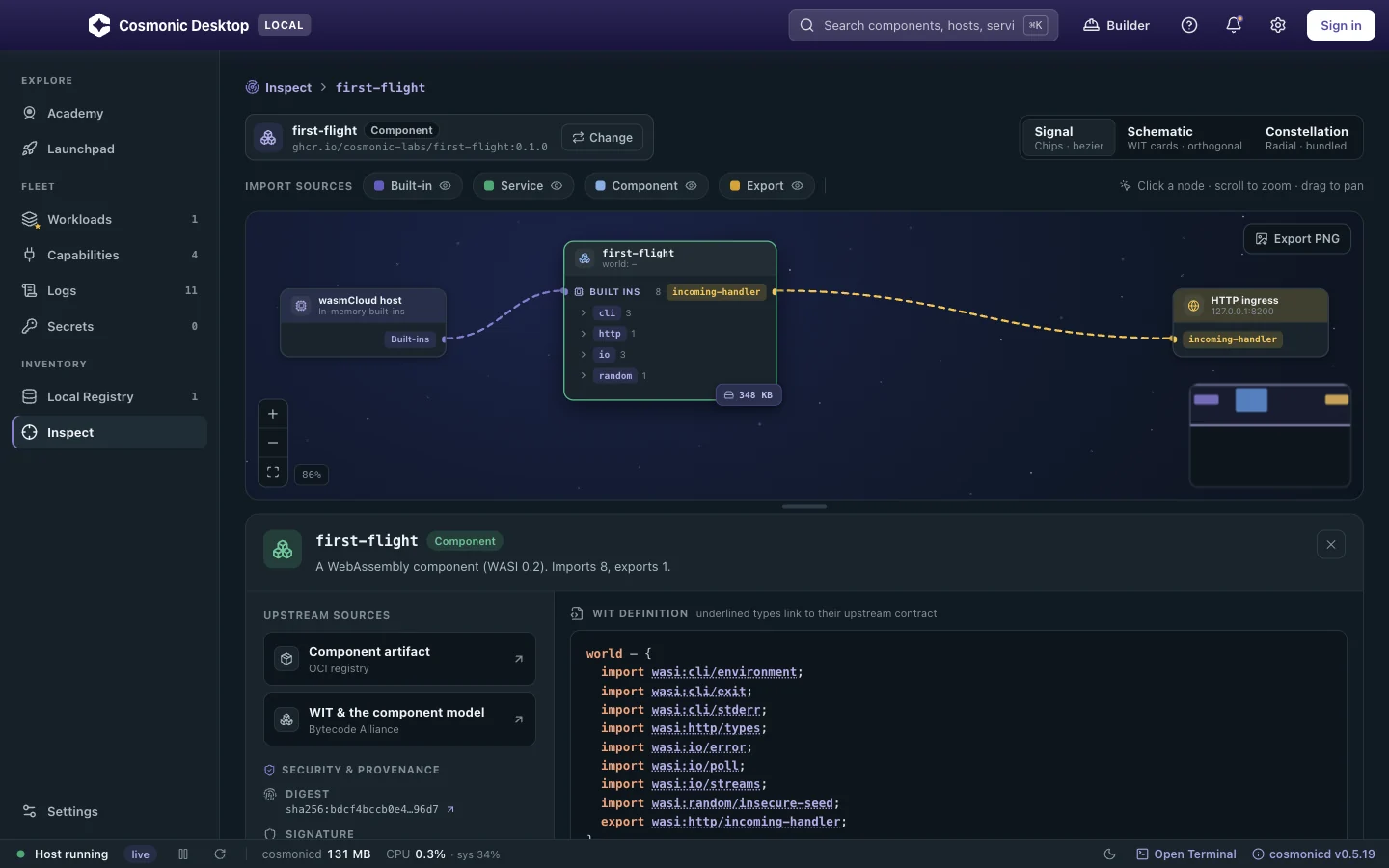
Public betaCosmonic Desktop runs this deny-by-default model on your own machine, free forever for personal use, with no account and no cloud. Download the public beta, or read the docs to build and run your first sandbox.